
- Home
- About Us
-
Products
- National Zero Till Seed Cum
Ferti Drill - National Zero Till Happy Seeder
- National Zero Till Multi Crop
Planter for 2 Wheel Tractor
(Direct Hitch/Power Tiller) - National Direct Seeder for
Rice (Multi Crop) - National Seed Cum Fertilizer Drill
- National Multi Crop Planter
- National Multi Crop Planter for
Mini Power Tiller - National Multi Crop Ridge Planter
- National Raised Bed Planter
- National Pneumatic Planter
- National Fertilizer Spreader
- National Vegitable Nursery
Transplanter - National Axil Flow Vegetable
Seed Extractor - National Grond Nut Digger
- National Post Hole Digger
- National Maize Sheller
No-Tillage Equipment
Tillage Equipment
Ridge Planter Equipment
Bed Planter Equipment
Precision Planter Equipment
Fertilizer & Nursery Equipment
Specialized Seed Extractors
& Vegetable Equipme
Urea Deep Placement
- National Zero Till Seed Cum
- Blogs
- Awards
- Career
- Gallery
Contact Us
Become a Dealer
Become a Vendor
Best Low-Cost Farm Equipment for Small & Marginal Farmers (2026)
07, September, 2026
Best Low-Cost Farm Equipment for Small & Marginal Farmers (2026)
If you’re working three acres in Punjab or half a hectare in Bihar, tractor showroom guys love to try and sell you 50-horsepower monsters with massive price tags. It’s infuriating. Big machinery looks great in brochures, but when you’re navigating narrow village bunds or trying to keep diesel costs from eating your entire margin, those oversized rigs are just a fast way to go broke.
Small farms don't need giant tractors. They need smart, targeted tools that save your back, slash labor costs during peak season, and don't require taking out a second mortgage to buy.
Why "Bigger Machine = Better" Is the Wrong Advice for Small Holdings
Big equipment fails small farmers for three very practical reasons: maneuverability, soil health, and math.
Try turning a 15-foot wide implement inside a quarter-acre plot framed by trees and irrigation channels—you'll spend half your morning just backing up and turning around. Then there's weight. Heavy tractors pack down small plots into hardpan clay, making root growth a nightmare for sensitive crops like pulses or vegetables. But mostly, it’s the payback period. A 4-lakh implement sitting idle in a shed for 10 months of the year is dead money. Small holdings win on low overheads and high yield per square foot, not sheer horsepower.
Sowing Equipment That Fits a Small Budget
Sowing by hand is brutal work, and broadcasting seed wastes far too much grain to birds and uneven depth. You want precise line-sowing without spending a fortune.
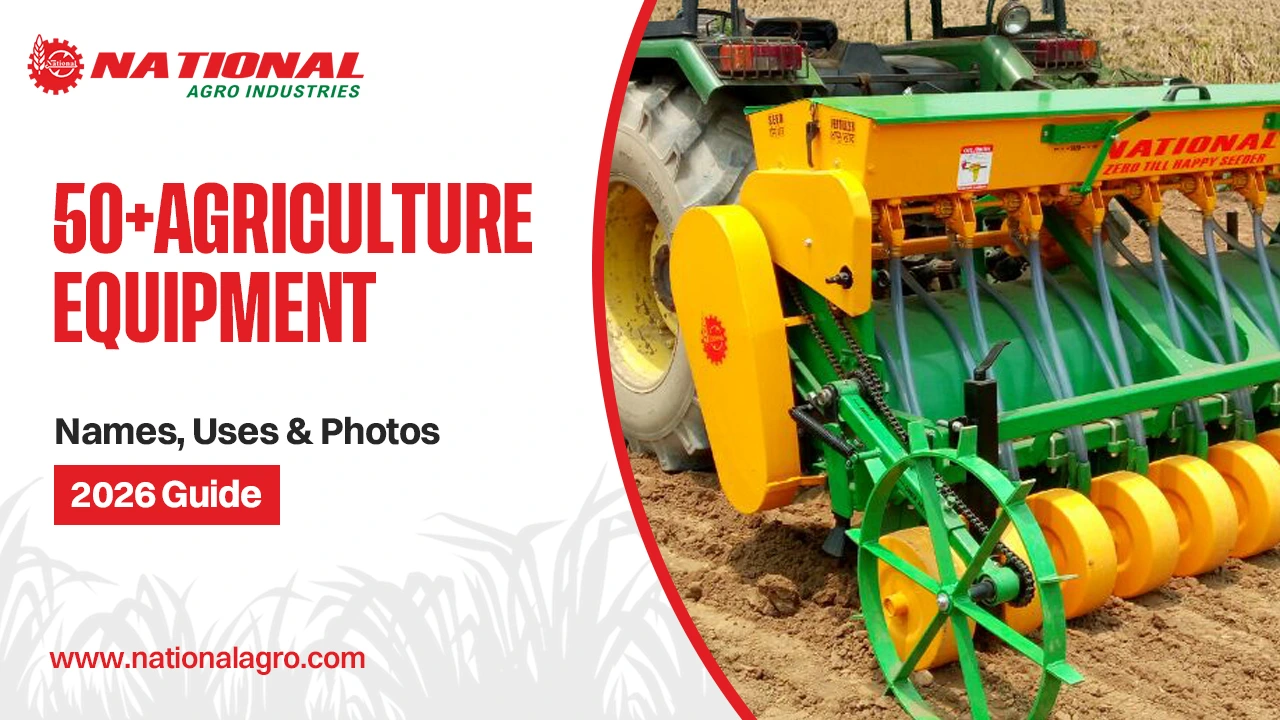
For small plots, compact line-planters and power-tiller mounted seed drills are absolute game-changers. Equipment like the National Multi Crop Planter or mini power-tiller seed drills lets you drop seeds at exact, pre-set intervals—whether you’re planting maize, cotton, or groundnuts. Stepping up to a scaled seed drill gives you the row accuracy of commercial farms at a fraction of the weight and fuel consumption.
Fertilizer Application Without a Big Spreader
Flinging urea across a field by hand is wasteful. Half of it lands on the weeds between rows, and the rest evaporates under the hot sun. Big broadcast spreaders aren't much better for small plots because they dump chemical inputs everywhere instead of right where the roots need them.
For marginal holdings, look at dual-function seed-cum-fertilizer drills or specialized deep placement tools like the National UDP/FDP Placement systems. By placing fertilizer directly into the furrow next to the seed line (placement instead of broadcasting), you can often cut your fertilizer buying by 20% to 30% while actually getting better crop response. That extra money stays right in your pocket.
Harvesting Aids for Small Plots (groundnut, maize)
Harvesting maize and groundnuts by hand leaves your back aching for weeks and costs a fortune when labor is scarce. But giant combine harvesters won't even fit through the village gate.
The middle ground lies in crop-specific, smaller machinery:
- Groundnut Diggers: Tractor-mounted groundnut diggers pop the pods out of the ground cleanly without snapping the roots, leaving them sitting right on top of the soil for easy pickup.
- Maize Shellers & Planters: Instead of paying five workers to strip cobs, a tractor PTO-driven unit like the National Maize Sheller cleans barrels of corn in minutes. Pair it with a dedicated multi-crop ridge planter during sowing season to keep row distances wide enough for easy manual harvesting later.
What to Prioritize First If You Can Only Buy One Machine
If your budget only allows for a single machinery purchase this season, prioritize planting equipment.
Why? Because your harvest yield is locked in the day you put seeds in the ground. Bad seed spacing leads to overcrowded, weak plants or empty patches that grow weeds. A solid seed-cum-fertilizer drill or multi-crop planter guarantees proper depth, perfect line spacing, and uniform germination across every row. Once your crop grows in clean, straight lines, everything else—weeding, spraying, and harvesting—becomes ten times easier to manage by hand.
FAQs
How long does it take for a small seeder machine to pay for itself?
Usually within 1 to 2 crop seasons. By cutting out two or three paid day-laborers during planting and reducing seed waste by 15-20%, a proper line-planter or small drill earns its purchase price back remarkably fast.
Will small implements handle tough, un-tilled soil?
It depends on the tines. Standard light seeders prefer tilled beds, but if you deal with hard soil or heavy residue, look specifically for equipment equipped with heavy-duty zero-till tines designed to slice into undisturbed ground.
Find the Right Tools for Your Acreage
Don't let big equipment dealers convince you to buy more machine than your land requires. Choosing equipment matched to your actual plot size keeps your farm profitable and manageable. Check out National Agro to explore precision seed drills, multi-crop planters, and small-farm implements designed to maximize your yield without draining your savings.4


QR Code