
- Home
- About Us
-
Products
- National Zero Till Seed Cum
Ferti Drill - National Zero Till Happy Seeder
- National Zero Till Multi Crop
Planter for 2 Wheel Tractor
(Direct Hitch/Power Tiller) - National Direct Seeder for
Rice (Multi Crop) - National Seed Cum Fertilizer Drill
- National Multi Crop Planter
- National Multi Crop Planter for
Mini Power Tiller - National Multi Crop Ridge Planter
- National Raised Bed Planter
- National Pneumatic Planter
- National Fertilizer Spreader
- National Vegitable Nursery
Transplanter - National Axil Flow Vegetable
Seed Extractor - National Grond Nut Digger
- National Post Hole Digger
- National Maize Sheller
No-Tillage Equipment
Tillage Equipment
Ridge Planter Equipment
Bed Planter Equipment
Precision Planter Equipment
Fertilizer & Nursery Equipment
Specialized Seed Extractors
& Vegetable Equipme
Urea Deep Placement
- National Zero Till Seed Cum
- Blogs
- Awards
- Career
- Gallery
Contact Us
Become a Dealer
Become a Vendor
Fertilizer Spreader vs Broadcaster: Which One Should You Buy?
23, September, 2026
Fertilizer Spreader vs Broadcaster: Which One Should You Buy?
You stand near the sheds before sowing season starts, looking over a line of machinery. Some blokes call them spreaders. Others call them broadcasters. You talk to two different farmers down the road, and you’ll get three different answers on what you actually need to fling urea or DAP across your fields.
When rain is coming, the soil is ready, and fertilizer prices are biting into your bottom line, buying the wrong implement hurts. You end up with dark green streaks across the paddock, patchy crop growth, and money sitting wasted in uneven strips.
Sorting out how these implements actually throw material on real dirt is the best place to start.
Spreader or Broadcaster — Is There Even a Difference?
In broad terms, "fertilizer spreader" covers pretty much anything built to put nutrients onto the ground. A "broadcaster" is just a specific style under that umbrella.
Here is how the machinery breaks down out in the field:
- Broadcasters (Centrifugal / Rotary Spreaders): These rely on spinning plates positioned at the bottom of a hopper. As granular fertilizer drops through the gate, high-speed vanes hurl the material out in a wide arc. They cover big ground fast, but you need your tractor speed and PTO revs steady so you don't throw heavy in the middle and thin on the edges.
- Drop Spreaders: Instead of slinging fertilizer sideways, a drop spreader lets granules fall straight down through a long row of openings underneath the hopper. The spread pattern matches the exact width of the frame. It gives dead-accurate placement along fences or sensitive borders, but trying to cover a fifty-acre paddock three meters at a time will test anyone’s patience.
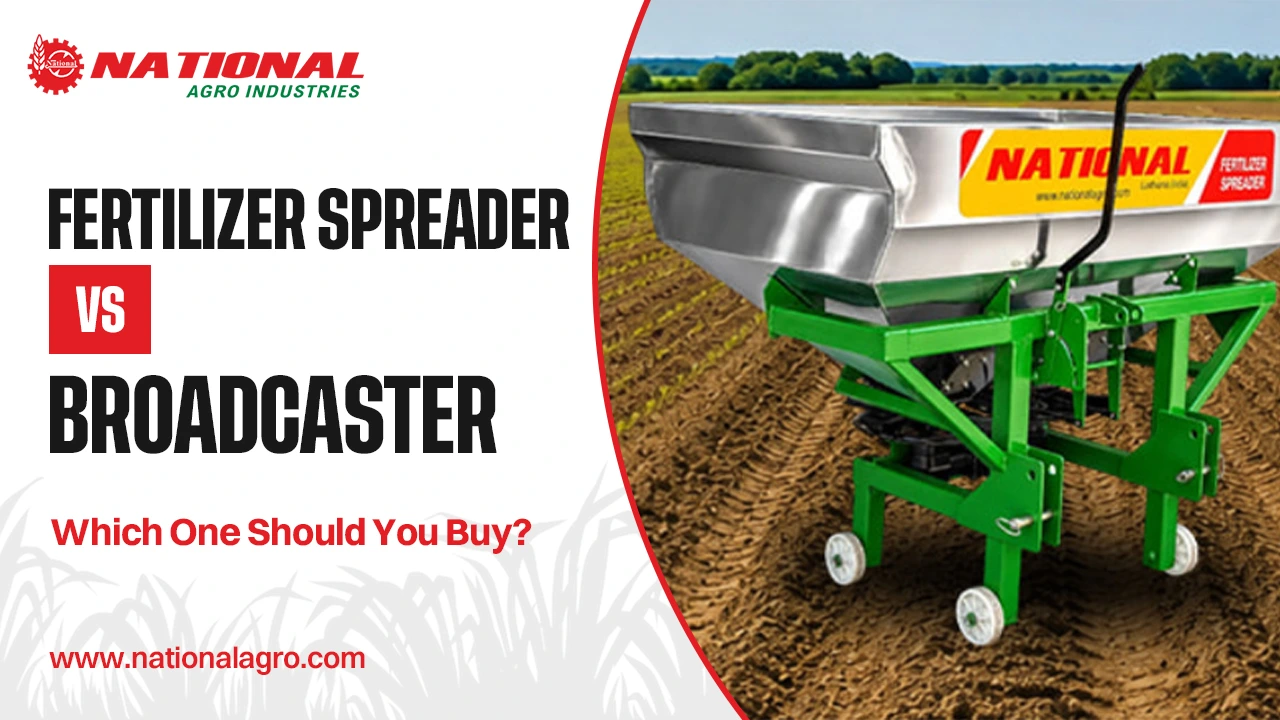
Tractor-mounted, PTO-driven centrifugal units—like the National Fertilizer Spreader—are what most commercial growers lean on when they need to get across broad acres without dragging out the job.
Walk-Behind and Manual Spreaders — Best For Small Holdings
When you’re managing an orchard block, a small vegetable plot, or working inside greenhouses, bringing a full-sized tractor rig between tight rows just doesn't work. Smaller manual gear makes more sense here:
1. Walk-Behind Push Units
These run on two main wheels supporting a poly or steel tub. As you push the frame forward, the axle turns a simple gear drive that spins the bottom plate. A lever up on the handlebar lets you pull open the feed gate when you start moving.
- The Advantage: Lightweight, easy to store, and simple to turn in tight corners near fence lines.
- The Catch: Your walking legs set the swath width. Walk too quick up a flat strip and you throw granules wider than planned; slow down while pushing uphill and you dump a thick dose right on the roots.
2. Chest-Mounted Hand-Crank Spreaders
These hang from a strap over your shoulder, positioning a small hopper right at chest height. You turn a side crank with one hand to spin the disc while holding the frame or adjusting the chute lever with the other.
- The Advantage: Unmatched on wet, muddy ground or rough terraces where wheels slip and bog down.
- The Catch: Carrying twenty kilos of dense granules on your chest gets tiring quickly. Fine for a quick patch job, but useless for broad acreage.
Tractor-Operated / PTO Fertilizer Broadcasters — Best For Commercial Farms
Once paddock sizes grow, spreading by hand or push cart becomes a massive time sink. This is where three-point linkage, PTO-driven broadcasters take over.
These hook straight onto the back of the tractor. Instead of relying on ground wheels to turn the mechanism, the tractor's PTO shaft powers heavy gearboxes that keep the spinning plates turning at a constant, high speed.
What Matters on a Heavy-Duty Tractor Broadcaster:
- High Hopper Capacity: Implements like the National NFS1000 carry up to 1000 liters of dry fertilizer in one go. That keeps you in the paddock longer instead of constantly driving back to the bulk bags to refill.
- Twin Spinning Discs: Dual rotating plates fitted with angled vanes balance out the throw. That prevents the machine from heavily bias-throwing to one side of your tractor track.
- Protection Against Corrosion: Fertilizer acts like salt on exposed steel. Solid commercial units go through shot-blasting, anti-rust primers, and thick PU topcoats to keep the hopper and frame from rusting out after a couple of seasons handling damp urea.
- Simple Flow Adjustment: Mechanical levers let you dial in the opening size of the discharge gates. When you pair a set gate opening with a consistent gear and engine revs, you can lay down exact rates of DAP, urea, or blended NPK across wheat, paddy, maize, and sugarcane.
Equipment Type Comparison
Matching the right implement to your farm comes down to paddock size, required working width, and how fast you need to get the job finished.
|
Feature / Metric |
Walk-Behind Spreader |
Tractor-Mounted Broadcaster (PTO) |
Drop Spreader |
|
How It Spreads |
Spinning plate powered by wheel axle |
Dual spinning discs driven by tractor PTO |
Direct gravity drop straight down beneath hopper |
|
Working Width |
2 to 4 meters |
Wide multi-meter broadcast arc |
Exact width of the frame (1 to 2.5 meters) |
|
Ground Speed |
3 to 4 km/h (walking pace) |
8 to 12 km/h (tractor working speed) |
3 to 5 km/h |
|
Pattern Spread |
Fair (changes with walking pace) |
High (balanced twin discs at fixed PTO revs) |
Very Precise (no side throw overlap) |
|
Best Suited For |
Small plots, nurseries, home paddocks |
Wheat, rice, maize, sugarcane, broad-acre crops |
Headlands, orchard strips, precise nursery beds |
|
Material Needed |
Dry granular products |
Dry granular fertilizers |
Dry granules and fine dry materials |
FAQs
Why is my double-disc broadcaster throwing more fertilizer on one side?
If a twin-disc unit throws unevenly, the issue usually sits with an unlevel top link or lower arms, worn vanes on one disc, a partial blockage in one feed gate, or the drop point hitting off-center on the plate. Leveling the machine on flat ground and checking that both discharge gates open evenly usually clears it up.
How do I calibrate a broadcaster for the right rate?
Calibrating comes down to three things: gate setting, ground speed, and PTO speed. Measure how much fertilizer comes out over a known distance at your standard gear and engine speed (usually around 8 to 12 km/h), then calculate the area covered to confirm your rate per hectare before doing the whole field.
What stops granular fertilizer from clumping up in the hopper?
Products like urea draw moisture out of humid air fast. Fill the hopper right before you drive out to spread, and never leave fertilizer sitting in the tub during lunch breaks or overnight. Make sure to break up any soft bag lumps before pouring them into the machine.
What washdown routine keeps these machines lasting?
Hose the entire implement down thoroughly with clean water as soon as you finish spreading. Once the machine dries off, grease the PTO universal joints, check the oil levels in the gearboxes, touch up any bare metal scratches, and park the unit inside a dry shed.
Ready to Work Your Fields Faster?
If you want to speed up your spreading runs and keep your nutrient application even across every hectare, take a look at the tractor-mounted range at National Agro Industries. Built around heavy-duty frames, CNC-machined components, and tough protective coatings, they're made to handle hard seasonal work without hassle.


QR Code