- Home
- About Us
-
Products
- National Zero Till Seed Cum
Ferti Drill - National Zero Till Happy Seeder
- National Zero Till Multi Crop
Planter for 2 Wheel Tractor
(Direct Hitch/Power Tiller) - National Direct Seeder for
Rice (Multi Crop) - National Seed Cum Fertilizer Drill
- National Multi Crop Planter
- National Multi Crop Planter for
Mini Power Tiller - National Multi Crop Ridge Planter
- National Raised Bed Planter
- National Pneumatic Planter
- National Fertilizer Spreader
- National Vegitable Nursery
Transplanter - National Axil Flow Vegetable
Seed Extractor - National Grond Nut Digger
- National Post Hole Digger
- National Maize Sheller
No-Tillage Equipment
Tillage Equipment
Ridge Planter Equipment
Bed Planter Equipment
Precision Planter Equipment
Fertilizer & Nursery Equipment
Specialized Seed Extractors
& Vegetable Equipme
Urea Deep Placement
- National Zero Till Seed Cum
- Blogs
- Awards
- Career
- Gallery
Contact Us
Become a Dealer
Become a Vendor
Seeder vs Planter: A Farmer's Guide to Choosing the Right Machine
31, July, 2026
Seeder vs Planter: A Farmer's Guide to Choosing the Right Machine
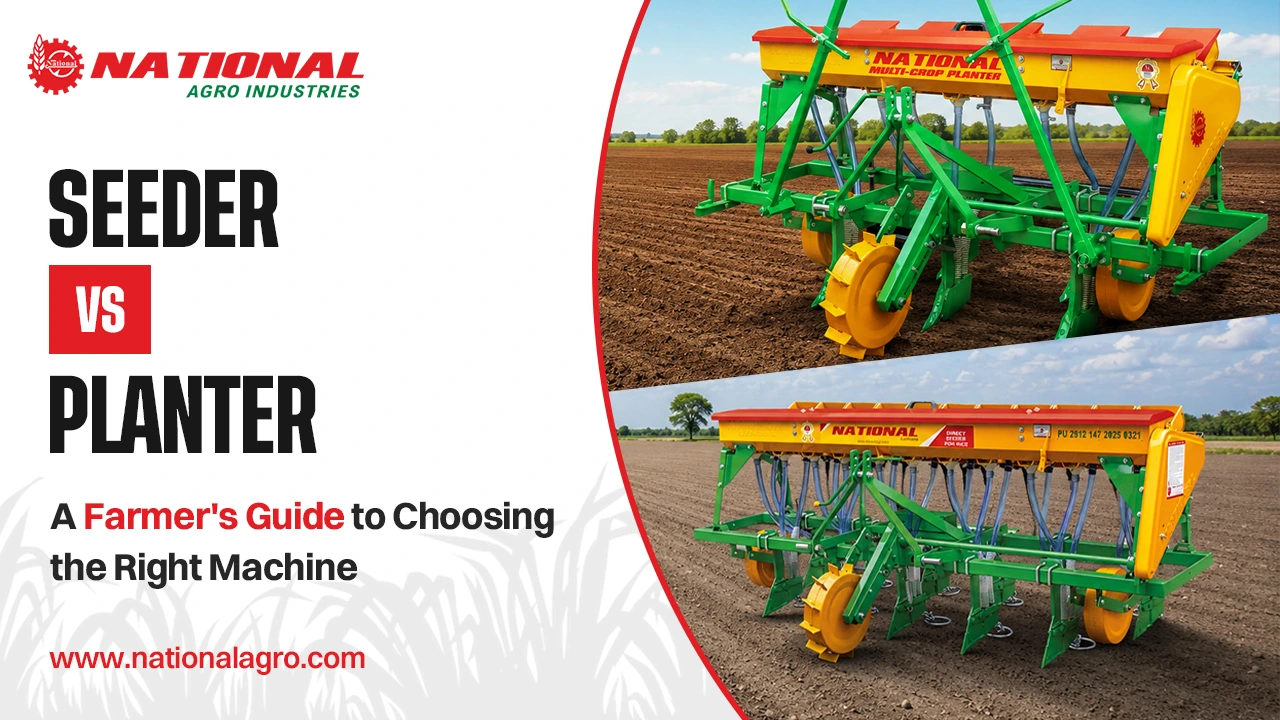
If you're wondering which one you actually need, here's the short answer: a seeder is built for crops that grow close together in continuous rows, like wheat, barley, and pulses, where seeds get spread evenly along the row. A planter is built for row crops that need precise spacing between individual seeds, like maize, soybean, sunflower, and groundnut. If your field looks like a dense green carpet at harvest, you probably need a seeder. If it looks like neat rows of individual plants standing apart, you need a planter.
That's the basic split. But the real decision comes down to what you're growing, how your soil behaves, and what kind of yield you're chasing. Let's get into it.
What Does a Seeder Actually Do?
A seeder's whole job is continuous seed placement. It drops seeds in a steady stream along a furrow, so the spacing between individual seeds isn't tightly controlled, but the row spacing is.
This works great for crops where you want a dense, uniform stand rather than individually spaced plants. Think wheat, barley, and most pulses. You're not trying to give each seed its own little patch of soil. You want good coverage across the row and consistent depth so germination happens evenly.
Most seeders on the market today, including our own Seed Cum Fertilizer Drill, also place fertilizer right alongside the seed in the same pass. That's one less trip across the field, which matters more than people realize once fuel and labor costs start adding up.
What Does a Planter Actually Do?
A planter is a different kind of precision. It picks up and drops one seed at a time, at a set spacing, at a set depth. No clumping, no gaps.
This matters a lot more for crops like maize, soybean, and groundnut, where every plant needs its own space to develop a proper root system and canopy. Overcrowd these crops and you'll see stunted growth, more competition for nutrients, and a noticeably lower yield come harvest. Underspace them and you're wasting good field area.
Our Pneumatic Planter uses vacuum-based seed metering for this exact reason. It's not about dropping more seeds faster, it's about dropping the right number of seeds in exactly the right spot, every single time.
So How Do You Actually Decide?
Here's where farmers usually get confused, because the answer isn't purely about the crop. It's also about the soil and the setup you're working with.
Go with a seeder if:
- You're growing wheat, barley, mustard, or most pulses
- You want continuous, even seed distribution across the row
- You're also looking to place fertilizer in the same pass
Go with a planter if:
- You're growing maize, soybean, sunflower, groundnut, or other row crops
- Individual plant spacing directly affects your yield
- You want precision over volume
One thing I'll mention because farmers ask this constantly: some of you are growing a mix of both crop types across different seasons or plots. In that case, it's worth looking at multi-crop planters that can be adjusted for different seed sizes and spacing requirements instead of buying two separate machines. It saves on both cost and storage space in your shed.
Don't Forget Your Soil and Sowing Method
Whichever machine you pick, it also needs to match your tillage practice. If you're doing zero-till or working with heavy crop residue, you'll want a machine built with tines designed for undisturbed soil, not one meant for freshly tilled, loose ground. This is a common mistake we see: farmers buy the right seeder or planter for their crop but the wrong one for their field conditions, and then wonder why germination is patchy.
Quick Recap
- Seeders are for continuous-row crops like wheat, barley, and pulses where even distribution matters more than individual spacing.
- Planters are for row crops like maize, soybean, and groundnut where precise seed spacing directly impacts yield.
- Fertilizer-integrated seeders save you an extra pass across the field.
- Pneumatic and vacuum-metered planters give you the precision that dense row crops actually need.
- Always match your machine to your soil and tillage method, not just your crop.
Not sure which setup fits your farm? Talk to our team and we'll help you pick the right seeder or planter based on your crop, soil type, and field size, no guesswork needed.


QR Code