- Home
- About Us
-
Products
- National Zero Till Seed Cum
Ferti Drill - National Zero Till Happy Seeder
- National Zero Till Multi Crop
Planter for 2 Wheel Tractor
(Direct Hitch/Power Tiller) - National Direct Seeder for
Rice (Multi Crop) - National Seed Cum Fertilizer Drill
- National Multi Crop Planter
- National Multi Crop Planter for
Mini Power Tiller - National Multi Crop Ridge Planter
- National Raised Bed Planter
- National Pneumatic Planter
- National Fertilizer Spreader
- National Vegitable Nursery
Transplanter - National Axil Flow Vegetable
Seed Extractor - National Grond Nut Digger
- National Post Hole Digger
- National Maize Sheller
No-Tillage Equipment
Tillage Equipment
Ridge Planter Equipment
Bed Planter Equipment
Precision Planter Equipment
Fertilizer & Nursery Equipment
Specialized Seed Extractors
& Vegetable Equipme
Urea Deep Placement
- National Zero Till Seed Cum
- Blogs
- Awards
- Career
- Gallery
Contact Us
Become a Dealer
Become a Vendor
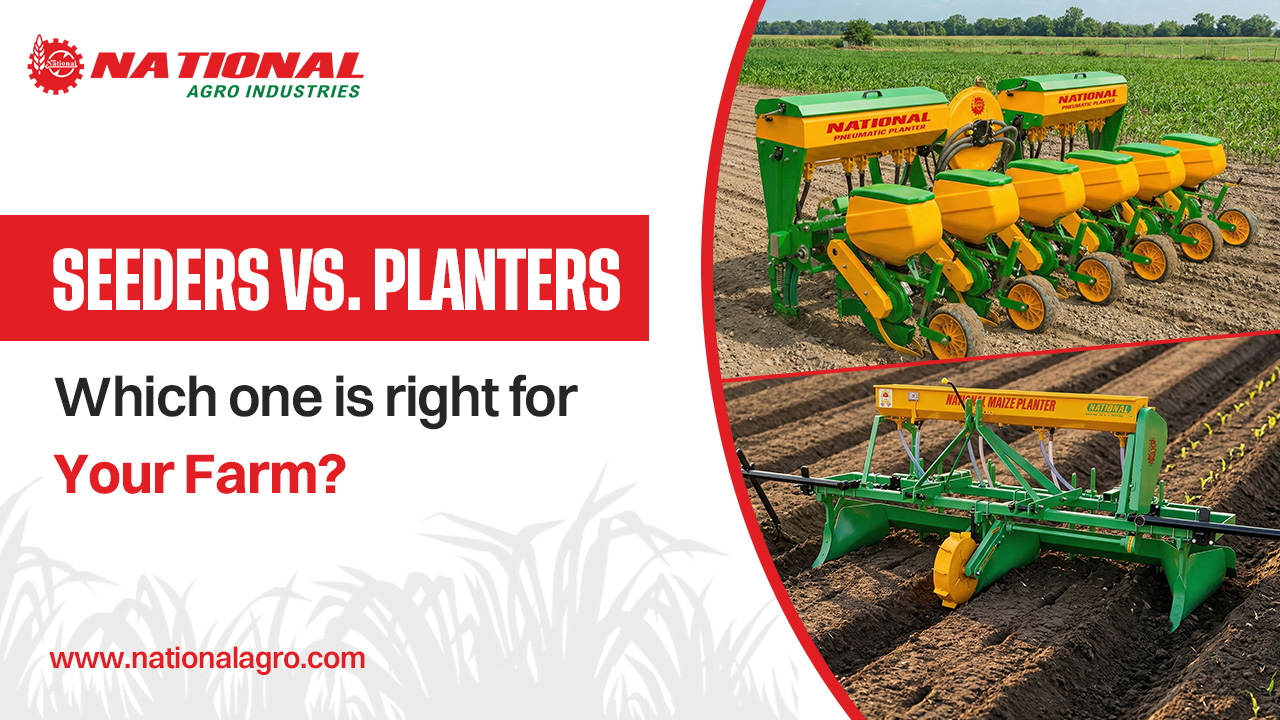
Seeders vs. Planters Which One is Right for Your Farm?
08, April, 2026
Seeders vs. Planters Which One is Right for Your Farm?
Every farmer knows that the journey to a bountiful harvest begins the moment a seed touches the soil. However, a common question often arises during the pre-sowing season: Should I use a seeder or a planter?
While these terms are sometimes used interchangeably in casual conversation, they represent two very different mechanical approaches to sowing.
Choosing the wrong equipment can lead to uneven germination, wasted seeds, and ultimately, reduced yields.
In this comprehensive guide, we will break down the differences between seeders vs. planters, explore their unique benefits, and help you decide which one is the right investment for your land.
What is a Seeder? (The Volume Specialist)
A seeder, often referred to as a seed drill, is designed for "mass sowing." It handles crops that are typically planted in close rows where individual plant spacing isn't as critical as the overall density of the field.
How it Works
Seeders work by creating a continuous furrow in the soil, dropping seeds into it at a relatively high speed, and then covering them back up. The seeds are distributed based on volume rather than a specific numerical count.
If you are looking for a reliable entry-point into this technology, the National Seed Cum Fertilizer Drill is a classic example of a machine that handles both seed and nourishment in one pass.
Best Crops for Seeders
Seeders are ideal for small grains and "solid-stand" crops, such as:
- Wheat
- Barley
- Oats
- Rice
- Cover crops
Key Benefits of Seeders
- Speed: You can cover vast acreages very quickly.
- Versatility: Many modern drills, like the National Zero Till Ferti Seed Drill, allow you to plant directly into stubble, saving time and fuel.
- Cost-Effective: Generally, seeders have fewer moving parts than precision planters, making them easier to maintain.
What is a Planter? (The Precision Architect)
A planter is a more sophisticated piece of machinery designed for "row crops." Unlike a seeder, a planter is obsessed with accuracy. It places individual seeds at a specific distance from one another and at a very precise depth.
How it Works
Planters use sophisticated metering systems (either mechanical or pneumatic) to pick up one seed at a time. This ensures that every plant has enough "elbow room" to grow without competing with its neighbor for sunlight, water, and nutrients.
For those looking for top-tier accuracy, the National Pneumatic Planter uses air pressure to ensure virtually zero skips or doubles.
Best Crops for Planters
Planters are the gold standard for crops that require specific spacing, such as:
- Maize (Corn)
- Soybeans
- Sunflowers
- Cotton
- Groundnuts
Key Benefits of Planters
- Maximum Yield Potential: By eliminating "crowding," each plant reaches its full genetic potential.
- Seed Savings: Because you aren't over-sowing to compensate for unevenness, you spend less on expensive hybrid seeds.
- Adaptability: Equipment like the National Multi Crop Ridge Planter allows you to plant on raised beds, which is vital for drainage and root health.
Key Differences Between Seeders and Planters
To make an informed choice, let’s compare them across four critical categories:
1. Seed Placement and Spacing
- Seeders: They focus on "seeds per foot" or "pounds per acre." The spacing between seeds within the row is random.
- Planters: They focus on "singulation." This means the machine ensures only one seed is dropped at exact intervals (e.g., exactly 6 inches apart).
2. Row Width
- Seeders: Usually have very narrow row spacing, often between 6 to 10 inches.
- Planters: Designed for wider rows, typically ranging from 15 to 30 inches or more, to allow for inter-culture activities or specialized harvesting.
3. Soil Disturbance
Many modern farmers are moving toward "No-Till" or "Zero-Till" farming to preserve soil moisture and health.
- The National Zero Till Happy Seeder is a revolutionary tool that manages heavy residue while sowing.
- Planters can also be outfitted for no-till, but they are often used in systems where soil is prepared into ridges or beds, such as with the National Raised Bed Planter.
4. Complexity and Cost
Planters are generally more expensive and require more calibration because of their precision components. Seeders are simpler "workhorses" that are easier for smaller operations to manage.
Which One is Right for Your Farm?
Deciding between the two depends on several factors:
What are you growing?
If your primary crops are wheat and rice, a high-quality National Rice Grain Planter or seed drill is your best bet. If you are moving into cash crops like maize or vegetables, a National Maize & Multi Crop Planter is essential.
What is your soil type?
For heavy, wet soils, planting on ridges is often necessary. In these cases, look for specialized equipment like the National Multi Crop Ridge Planter. If you are in a dry region looking to conserve moisture, a Zero-Till seeder is the way to go.
What is your tractor size?
Not everyone has a high-horsepower tractor. If you operate on a smaller scale, there are options like the National Multi Crop Planter for Power Tillers or even Mini Power Tillers. These allow small-hold farmers to achieve professional-grade precision without massive capital investment.
The Complete Ecosystem
While choosing between a seeder and a planter is a major step, successful farming requires a full suite of tools. For example, once your crop is grown, you may need a National Maize Sheller for processing or a National Ground Nut Digger for harvesting.
We have been part of the farming community's for decades, providing innovative solutions that bridge the gap between traditional wisdom and modern technology. You can explore our full range of Products to see how we support every stage of the agricultural cycle.
Conclusion
In the debate of Seeders vs. Planters, there is no single "winner." The best machine is the one that aligns with your specific crops, soil conditions, and budget.
- Choose a Seeder if you want speed, simplicity, and efficiency for small grains and forage crops.
- Choose a Planter if you want precision, maximum yield per seed, and the ability to grow high-value row crops.
Still undecided? Our team at National Agro is here to help you analyze your farm's needs. You can Contact Us directly for a consultation or learn more About Us to see why thousands of farmers trust our implements.
Ready to upgrade your farm? Browse our Full Catalogue today and take the first step toward a more productive harvest!


QR Code