- Home
- About Us
-
Products
- National Zero Till Seed Cum
Ferti Drill - National Zero Till Happy Seeder
- National Zero Till Multi Crop
Planter for 2 Wheel Tractor
(Direct Hitch/Power Tiller) - National Direct Seeder for
Rice (Multi Crop) - National Seed Cum Fertilizer Drill
- National Multi Crop Planter
- National Multi Crop Planter for
Mini Power Tiller - National Multi Crop Ridge Planter
- National Raised Bed Planter
- National Pneumatic Planter
- National Fertilizer Spreader
- National Vegitable Nursery
Transplanter - National Axil Flow Vegetable
Seed Extractor - National Grond Nut Digger
- National Post Hole Digger
- National Maize Sheller
No-Tillage Equipment
Tillage Equipment
Ridge Planter Equipment
Bed Planter Equipment
Precision Planter Equipment
Fertilizer & Nursery Equipment
Specialized Seed Extractors
& Vegetable Equipme
Urea Deep Placement
- National Zero Till Seed Cum
- Blogs
- Awards
- Career
- Gallery
Contact Us
Become a Dealer
Become a Vendor
Super Seeder vs Happy Seeder: Which One Should You Buy?
30, August, 2026
Super Seeder vs Happy Seeder: Which One Should You Buy?
Every October, standard logic goes out the window. The air in the Malwa belt thickens with that familiar, stinging haze, the calendar starts ticking like a bomb, and you've got maybe ten days—maybe twelve if the weather holds—to get wheat seed into damp earth before yields drop. Step into any yard or dealership in GT Road, and suddenly everyone has an opinion on gearboxes, tines, and residue.
Look, terms get thrown around fast. Someone screams super seeder, the guy next to him swears by a Happy Seeder, the local mechanic is pushing a surface seeder, and your uncle is still holding onto his classic standard zero till drill setup.
It gets loud.
At National Agro, we’ve spent decades listening to farmers debate this over lukewarm chai. The truth? None of these are "magic" tools, but matching the wrong implement to a 45 HP engine will ruin your week real quick. Let’s talk about what actually happens when metal hits damp paddy stubble.
Why All Three of These Get Confused With Each Other
Blame the rush. When the paddy comes off, nobody has three weeks to idle around.
The confusion happens because on paper, every single one of these implements exists to do one job: stop you from setting a match to your field. Government officers lump them together in subsidy circulars, salesmen blur the lines, and suddenly a no till planter sounds like the exact same thing as a 900-kilo monster rig.
They aren't. Not even close.
It boils down to how much violence the machine does to the ground:
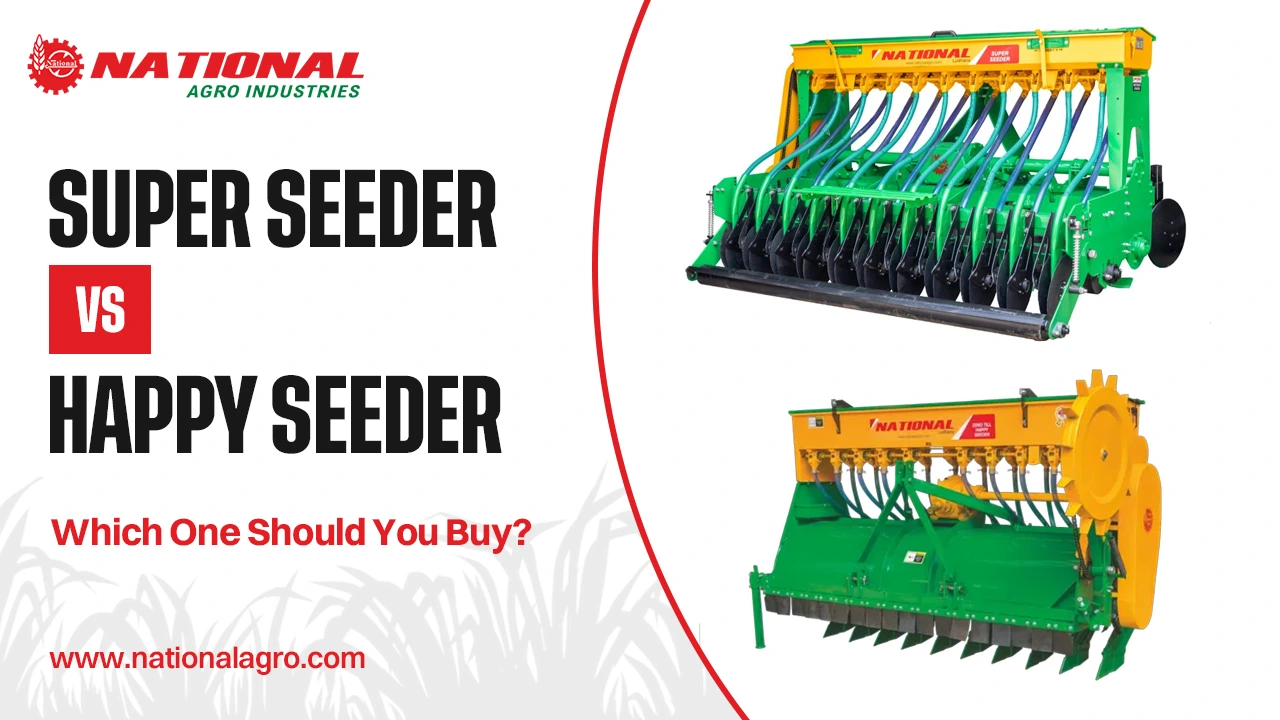
- Super Seeder: Blends everything. Eats standing stubble, chops it, buries it, seeds, and rolls the soil flat in one loud, heavy pass.
- Happy Seeder: Leaves the dirt alone. It slices the straw, drops the seed underneath, and tosses the cut residue right back over top like a yellow blanket.
- Zero Till Drill: Walks lightly. Needs low residue or a clean field, cutting neat little slits into the soil without tearing up the dirt between rows.
What a Super Seeder Actually Does (cutting + sowing in one pass)
Think of a super seeder machine as a rotavator and a precision planter glued together with heavy steel. It doesn't dodge paddy straw; it pulverizes it.
The front blades spin fast—real fast—chewing up damp roots and 18-inch stubble, mixing that biomass directly into the top three inches of dirt. Right behind that chaos, the tines drop seed and fertilizer into fresh soil, and a heavy roller presses it all flat.
You look back, and the field looks like a smooth brown garden bed. No loose straw blowing around. No waiting for extra tillage passes. But—and this is a big but—you are forcing your engine to do a massive amount of work all at once.
What a Happy Seeder Does Differently
A Happy Seeder is far more gentle on the soil structure.
Instead of turning your field into fine powder, flail blades chop the standing paddy stalks and fling them up and back. The sowing tines slice into raw, undisturbed soil underneath, drop the wheat, and then that chopped straw rains down over the sown row.
- The good part: That straw layer locks in soil moisture like crazy. Weeds hate it because light can't hit the ground.
- The headache: The field looks messy. If you're used to clean, pristine dirt, seeing a blanket of dead straw can feel wrong at first. Plus, if the straw is soaking wet from early morning dew, flails can sometimes jam up if you push too fast.
Zero-Till Drill — Where It Fits In
Then there’s the classic spatial zero till drill (or standard no till planter).
This is the old reliable option, but it has boundaries. It uses narrow inverted-T tines to slice tiny 2-inch furrows. It doesn't have big rotary flails to chew up heavy straw stacks.
If your combine harvester didn't run an SMS attachment—or if you haven't baled the field clean—a standard zero till drill will choke up with straw within fifty yards. But if the field is clear? It’s pure efficiency. You cruise along at lower RPMs, burn minimal diesel, and leave the soil biology totally intact.

Side-by-Side Comparison Table
|
Feature / Metric |
Super Seeder |
Happy Seeder |
Zero-Till Drill |
|
Residue Handling |
Buries and mixes straw into topsoil layer |
Lays cut straw on top as heavy surface mulch |
Handles light/baled residue only |
|
Soil Disturbance |
High (full-width rotor tilling) |
Low (slot slicing only) |
Minimal (narrow tine cuts) |
|
Tractor HP Required |
55 HP to 75+ HP (heavy pull) |
45 HP to 50 HP |
35 HP to 45 HP |
|
Diesel Usage |
Higher per acre (engine works hard) |
Moderate |
Very Low |
|
Machine Weight & Cost |
Heavy gear; higher initial price |
Medium weight; moderate cost |
Lightest build; economical |
|
Best-Fit Field State |
Heavy standing stubble, thick soil |
High-moisture soils needing mulch |
Clean fields, light residue |
Which One Should You Buy for Your Field?
Forget what your neighbor bought for a second. Look at your own garage and your own soil.
1. Check your tractor hood first
If you're running an older 45 HP tractor, taking home an 8-foot super seeder is just going to stall your engine and waste your afternoon. You need a solid 55 HP—preferably 60 to 75 HP with dual-clutch—to handle the weight and torque. For under 50 HP, lean toward a Happy Seeder or zero till setup.
2. How do you feel about surface straw?
Some farmers can't stand looking at straw sitting on top of their crop. If you want that classic, clean-tilled seedbed look where everything is tucked under, get the super seeder. If you care more about saving fuel and keeping ground moisture locked in through hot November days, the Happy Seeder wins.
3. Custom hiring business
If you rent your machinery out to other guys around the village, super seeders are what most clients ask for right now. People like seeing black soil after a single pass.
Super Seeder Price in 2026 — What Affects the Cost
Let's talk money, because prices aren't fixed numbers printed on a box.
When you check the super seeder price this season, you'll see gaps of ₹30,000 to ₹50,000 between machines that look nearly identical from ten feet away. What gives?
- Blade Material: Cheap rotor blades wear down to nubs after 150 acres of abrasive soil. High-grade boron steel blades cost more up front, but you won't be under the machine changing them out mid-season.
- Gearbox Specs: The heavy multi-speed gearbox is the heart of the unit. Skimping here means heat buildup and sheared pins.
- Tyne Count & Width: Standard 6-foot (11-tyne) models cost less and fit smaller tractors, while 7-foot and 8-foot versions demand bigger steel framing and higher investment.
- Subsidies: Don't forget state agricultural mechanization schemes. Depending on your local society or individual application status, government subsidies can slice 40% to 50% off the out-of-pocket machine cost.
(By contrast, the happy seeder price generally stays lower because the unit doesn't require the complex, heavy-duty rotavator drive assemblies that super seeders use.)
FAQs
Is super seeder better than happy seeder? Not flat-out "better"—just different tradeoffs. A super seeder gives you a clean seedbed and buries residue, but demands a bigger 55+ HP tractor and more fuel. A Happy Seeder saves fuel and creates great soil cover, but leaves straw visible on the surface.
Can I use a super seeder without a rotavator? Yes, absolutely. That’s the entire point of buying one. The machine has its own heavy-duty rotary tiller section up front. Running a rotavator beforehand is just wasting diesel.
What HP tractor do I need? You need a minimum of 55 HP for a standard 6-foot (11-tyne) super seeder. If you're going for a 7-foot or 8-foot model in heavy clay, stick to 65 HP to 75 HP to keep your speed up without cooking the engine.


QR Code