- Home
- About Us
-
Products
- National Zero Till Seed Cum
Ferti Drill - National Zero Till Happy Seeder
- National Zero Till Multi Crop
Planter for 2 Wheel Tractor
(Direct Hitch/Power Tiller) - National Direct Seeder for
Rice (Multi Crop) - National Seed Cum Fertilizer Drill
- National Multi Crop Planter
- National Multi Crop Planter for
Mini Power Tiller - National Multi Crop Ridge Planter
- National Raised Bed Planter
- National Pneumatic Planter
- National Fertilizer Spreader
- National Vegitable Nursery
Transplanter - National Axil Flow Vegetable
Seed Extractor - National Grond Nut Digger
- National Post Hole Digger
- National Maize Sheller
No-Tillage Equipment
Tillage Equipment
Ridge Planter Equipment
Bed Planter Equipment
Precision Planter Equipment
Fertilizer & Nursery Equipment
Specialized Seed Extractors
& Vegetable Equipme
Urea Deep Placement
- National Zero Till Seed Cum
- Blogs
- Awards
- Career
- Gallery
Contact Us
Become a Dealer
Become a Vendor
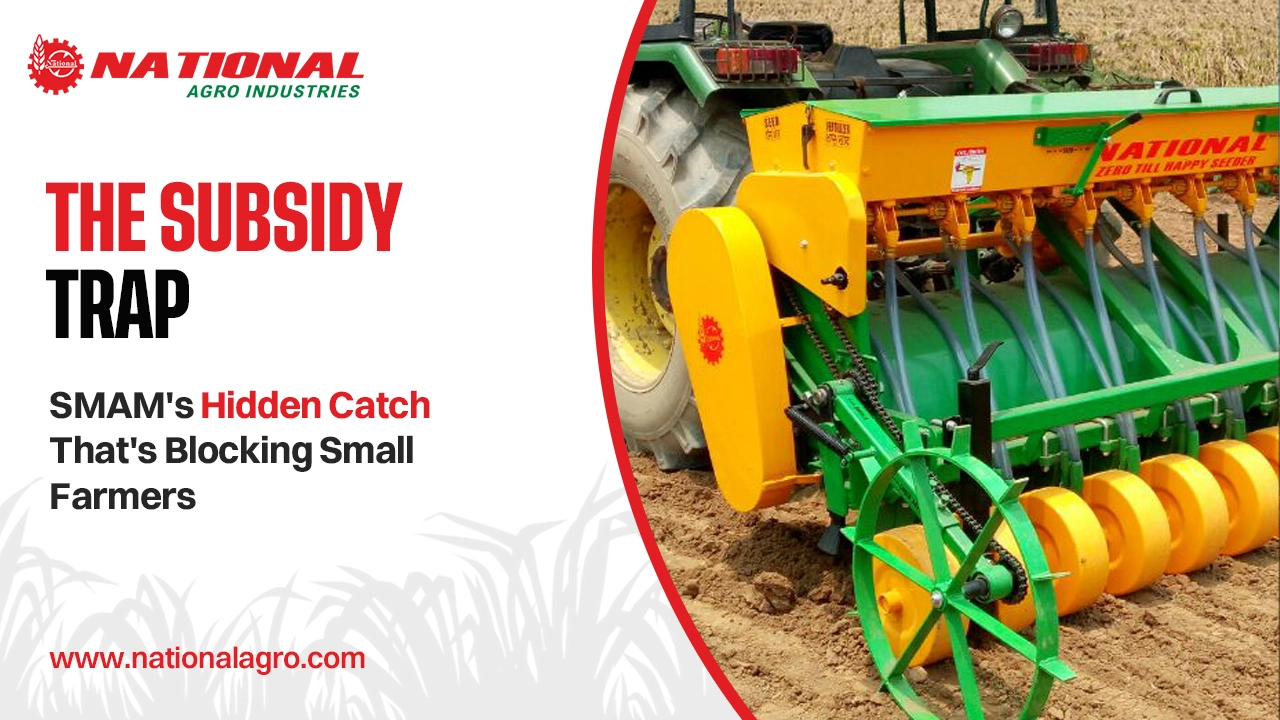
The Subsidy Trap: SMAM's Hidden Catch That's Blocking Small Farmers
25, July, 2026
The Subsidy Trap: SMAM's Hidden Catch That's Blocking Small Farmers
SMAM promises farmers 40 to 50% off the cost of new machinery, sometimes more. The catch is that most farmers have to pay the full price out of pocket first and wait for the subsidy to land in their account later. For a small or marginal farmer, that gap between paying and getting reimbursed is often the real barrier, not the paperwork.
If you've looked into SMAM and felt like something doesn't add up, you're not wrong. Here's what's actually going on.
The Scheme That Sounds Too Good to Be True
SMAM, or the Sub Mission on Agricultural Mechanization, is a central government scheme meant to make tractors, rotavators, seed drills, threshers and other equipment affordable for farmers who can't buy them outright. On paper, general category farmers get 40% off, SC/ST and small or marginal farmers get 50%, and in some cases, like the North Eastern states or Custom Hiring Centres, the subsidy can go as high as 80 to 100%.
It sounds like exactly what small farmers need. And it genuinely has helped a lot of people mechanize who otherwise couldn't have.
The part that trips people up isn't the subsidy percentage. It's how you actually get that money.
The Catch: Pay First, Get Reimbursed Later
SMAM runs on a Direct Benefit Transfer model. That means the subsidy isn't taken off the purchase price at the counter. You buy the machine at full price from an approved dealer, submit your documents, and wait for the department to verify everything before the subsidy amount gets credited to your bank account.
So if you're buying a rotavator that costs 80,000 rupees with a 50% subsidy, you still need to arrange the full 80,000 rupees upfront. The 40,000 rupees subsidy comes back to you later, sometimes weeks after the purchase, sometimes longer depending on your state's processing load.
For a farmer with savings or easy access to credit, that's an inconvenience. For a small or marginal farmer working on thin margins, that upfront amount is often simply not there. Many end up borrowing at high interest just to bridge the gap, which quietly eats into the value of the subsidy they were promised in the first place.
Why Harvest Season Makes It Worse
This gets worse when timing is involved. Crops don't wait for department approvals. If you need a harvester or a thresher during your harvest window, you're working with a matter of days, not months, before the crop is at risk of loss.
Custom Hiring Centres exist so farmers who can't afford their own machinery can rent it instead. It sounds like the workaround to the ownership problem. But a single well-functioning CHC typically serves somewhere between 100 and 200 farmers in its area. During peak harvest, when everyone needs the same machine in the same short window, that capacity gets stretched thin fast. Farmers can end up waiting in line for a rented harvester while their crop sits in the field.
This is exactly why national data shows such a wide gap in mechanization access. In Punjab, close to all paddy growing households use combine harvesters. In Bihar, it's a small fraction of that. The machinery access gap tracks closely with how well CHCs and mechanization support actually reach a region, not just whether a scheme exists on paper.
One Farmer's Story
Ramesh, a wheat farmer with about two acres of land in a district in Uttar Pradesh, decided to apply for a rotavator under SMAM last season. He was eligible for a 50% subsidy as a small farmer. The rotavator cost him close to 90,000 rupees.
"Nobody told me I'd have to pay the full amount first," he says. "I had to borrow from a relative just to make the purchase, and then I waited almost two months for the subsidy to come through. By the time it did, I'd already paid interest on the loan that ate into a good chunk of what I saved."
Ramesh's experience is common, not an outlier. Talk to farmers who've been through the SMAM process and you'll hear a version of this story again and again. The scheme isn't broken in its intent. It's broken in its timing.
What Experts Say Needs to Change
Agricultural economists have pointed out that a subsidy which requires full upfront payment isn't really accessible to the farmers it's designed for. As one farm economist put it in a policy discussion, a scheme meant to help small landholders needs to account for the fact that small landholders are the ones least likely to have 80,000 rupees sitting around.
Farmer union representatives have raised similar concerns, arguing that reimbursement timelines need to be brought down significantly, and that front-loaded subsidy models, where the discount is applied before purchase rather than after, would do far more for actual adoption among small and marginal farmers.
There's also been institutional criticism. A parliamentary committee reviewing the scheme has flagged that despite the scale of Custom Hiring Centres set up so far, more than 37,000 of them including over 17,000 Farm Machinery Banks, access remains uneven, and that machinery affordability continues to be a real constraint for farmers with fragmented, small landholdings.
What Farmers Can Do Right Now
You don't have to wait for policy reform to work around this. A few things actually help:
- Pool resources through a cooperative or FPO. Farmer Producer Organizations and Self Help Groups can receive higher subsidy rates, up to 80 to 90% in some cases, when setting up shared machinery access, which spreads the upfront cost across many farmers instead of one.
- Apply early in the application window, not during harvest crunch. States often open SMAM registration months before peak season. Applying early means your paperwork and verification are already moving before you actually need the machine.
- Book your CHC slot in advance rather than waiting until the week you need it. If you know your harvest window is coming, reserve machinery time ahead of the rush.
- Look at state-specific schemes alongside SMAM. Several states run their own mechanization subsidy programs with different disbursal structures, and some offer more favorable timing than the central scheme.
- Talk to your bank about short-term agri credit designed specifically to bridge subsidy gaps, rather than informal borrowing, since interest rates and terms are usually far better.
SMAM vs State-Specific Mechanization Schemes
|
SMAM (Central) |
State Schemes (varies by state) |
|
|
Subsidy range |
40-50% general, up to 80-100% for CHCs/FMBs and NE region |
Often 40-50%, varies widely |
|
Payment structure |
Pay full cost upfront, reimbursed after verification |
Varies, some states offer partial upfront discounts |
|
Application window |
Mostly year-round via central DBT portal, with state-specific cycles |
Fixed windows, often 2-3 months per year |
|
Best suited for |
Farmers who can arrange upfront capital or credit |
Farmers wanting to compare timing and local support options |
What Happens Next
There are signs of movement. The scheme has been folded into the broader Rashtriya Krishi Vikas Yojana framework, and the government's newer Digital Agriculture Mission is expected to bring more data-driven tracking into how subsidies and machinery access are managed. Parliamentary reviews have specifically flagged that the core mandate, reaching small and marginal farmers, shouldn't get diluted as the scheme scales up and merges with larger programs.
Whether that translates into faster reimbursement timelines or a front-loaded subsidy model remains to be seen. For now, the smartest move is knowing exactly how the system works before you commit your money.
Am I Eligible? Quick Checklist
- I am a farmer, FPO, SHG, or cooperative registered in India
- I have land records or relevant ownership/tenancy documents ready
- I have a bank account linked for Direct Benefit Transfer
- I can arrange the full upfront cost of the machine, or access short-term credit to cover it
- I have identified an approved dealer and machinery model under the scheme
If you checked most of these, you're likely eligible to apply. If the upfront cost is the sticking point, pooling through an FPO or CHC route is usually your best next step.
FAQs
Who is actually eligible for the SMAM subsidy? Individual farmers, Farmer Producer Organizations, Self Help Groups, cooperatives, panchayats, and rural entrepreneurs can all apply, with small, marginal, women, and SC/ST farmers typically getting higher subsidy rates than general category applicants.
Do I have to pay the full machine cost upfront? Yes, in almost all instances. The scheme operates under the principle of Direct Benefit Transfer, which means that the dealer will be paid in full by you and the subsidy amount is credited to your account.
What is Custom Hiring Centre and how to book it? The Custom Hiring Centre is a service that provides equipment for hiring, provided by a farmer or an entrepreneur, cooperative, FPO, and others. The best way to book a Custom Hiring Centre is directly from it or through your local agriculture department. It is better to book ahead of time.
Are there schemes that don't require upfront payment? Some Farm Machinery Bank and CHC setups involve higher direct financial support to the operating group rather than the individual farmer, which reduces the upfront burden. It's worth checking your state's specific mechanization scheme too, since disbursal structures vary.
The Bottom Line
- SMAM's subsidy is real, but it works on reimbursement, not a discount, so you need upfront capital or credit first
- Harvest season timing makes Custom Hiring Centre bottlenecks worse, so book early
- Pooling through an FPO, SHG, or cooperative usually gets you better rates and lower individual cost burden
- Comparing SMAM against your state's own mechanization scheme can reveal better timing or terms
- Knowing the process before you apply is what actually protects your money, not just knowing the subsidy percentage
Understanding how the scheme really works puts you in a much stronger position than most applicants. Talk to your local Krishi Vigyan Kendra or agriculture office to confirm your state's current application window, and start the paperwork before you're racing the harvest clock.


QR Code