
- Home
- About Us
-
Products
- National Zero Till Seed Cum
Ferti Drill - National Zero Till Happy Seeder
- National Zero Till Multi Crop
Planter for 2 Wheel Tractor
(Direct Hitch/Power Tiller) - National Direct Seeder for
Rice (Multi Crop) - National Seed Cum Fertilizer Drill
- National Multi Crop Planter
- National Multi Crop Planter for
Mini Power Tiller - National Multi Crop Ridge Planter
- National Raised Bed Planter
- National Pneumatic Planter
- National Fertilizer Spreader
- National Vegitable Nursery
Transplanter - National Axil Flow Vegetable
Seed Extractor - National Grond Nut Digger
- National Post Hole Digger
- National Maize Sheller
No-Tillage Equipment
Tillage Equipment
Ridge Planter Equipment
Bed Planter Equipment
Precision Planter Equipment
Fertilizer & Nursery Equipment
Specialized Seed Extractors
& Vegetable Equipme
Urea Deep Placement
- National Zero Till Seed Cum
- Blogs
- Awards
- Career
- Gallery
Contact Us
Become a Dealer
Become a Vendor
Why Farmers Are Skipping Stubble Burning for Smart Seeder
28, October, 2026
Why Farmers Are Skipping Stubble Burning for Smart Seeder
Stubble Burning Meaning, Causes & Machine-Based Alternatives
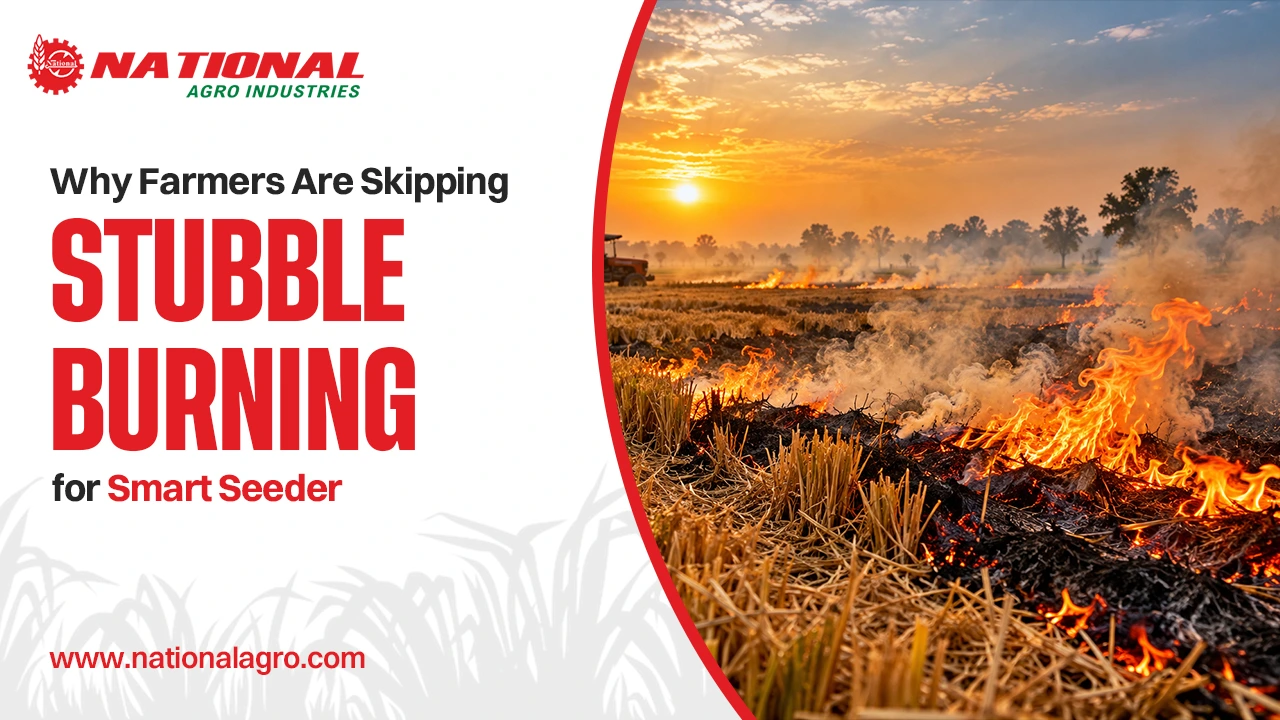
Stubble burning means setting fire to the straw and stalks left in a field after harvest, so the land can be cleared fast for the next crop. In north India it mostly means paddy stubble burning in October and November, done to make way for wheat. The practice is cheap and quick, but it costs the soil, the air and often the farmer. The good news is that you can now sow wheat straight into paddy straw with the right machine.
Stubble burning meaning in simple words
After a crop is harvested, two things stay in the field. One is the stubble, the short stalks still rooted in the ground. The other is loose straw, the chopped stems and leaves a combine harvester throws out behind it.
Crop stubble burning is the act of lighting all of that on fire. Farmers do it with paddy most of all, though wheat residue is burnt too. Paddy stubble burning peaks in the weeks after the paddy harvest, which in Punjab and Haryana means October and November.
Why farmers still burn crop stubble
Almost nobody burns straw because they enjoy it. Most do it because the timing and the economics push them there.
- The window is tiny. Farmers often get only two to three weeks between harvesting paddy and sowing wheat. Late sowing hurts the wheat crop.
- Combine harvesters leave a mess. A combine cuts the crop several inches above the ground and drops loose straw across the field, which is hard to clear by hand.
- Paddy straw has little value. It is high in silica, so it makes poor fodder, and there is rarely a ready buyer.
- Labour and cost. Clearing or ploughing in straw takes people, fuel and time. A match takes none of the three.
What burning costs you
It is not only a pollution story. It is a farm story too.
Your soil loses out. Straw carries nitrogen, phosphorus, potassium and sulphur. Burning wastes much of that, and the heat also harms the soil microbes that help crops take up nutrients.
Everyone breathes it. Smoke from Punjab and Haryana is regularly blamed for worse air in Delhi-NCR each winter.
You can be fined. Burning is banned, and the government fines farmers per incident. Under the rates notified in November 2024, the environmental compensation is Rs 5,000 for under 2 acres, Rs 10,000 for 2 to 5 acres and Rs 30,000 above 5 acres. Farmers can also get "red entries" against their land records.
Where Punjab stands today
The numbers have improved a lot, but the problem has not gone away. Punjab recorded 71,304 farm fires in 2021 and 36,663 in 2023. It recorded 10,909 in 2024 and 5,114 in 2025.
This season, Punjab had logged 717 incidents up to 27 October 2026, according to the Punjab Pollution Control Board. By mid-October the count was already running ahead of the same point last year. So the fall is real, but plenty of fields are still being burnt.
Machine-based alternatives to burning
The practical fix is to stop clearing the straw at all. Instead, sow the wheat straight through it. This is called in-situ management, and it is where seeding machines come in.
National Zero Till Happy Seeder. It sows wheat, sorghum, barley and pulses directly into the residue of the previous crop. A straw managing chopper lets it seed into the straw itself. The decaying straw then sits on the soil as mulch and adds fertility. A narrow seed and fertilizer boot keeps soil disturbance low.
National Smart Seeder. It is built for sowing wheat right after paddy harvest. It does seed-zone preparation, residue management, seed placement and seed covering in a single pass. A rotary tiller with J-type half-cut blades works only the seed zone, and double disc furrow openers place the seed through the paddy residue. It runs on tractors of 50 HP and above, and an optional multi crop planter attachment extends it to other crops.
|
Happy Seeder |
Smart Seeder |
|
|
Built for |
Direct seeding into residue |
Wheat straight after paddy |
|
How it handles straw |
Straw managing chopper |
Rotary tiller on the seed zone, press wheels |
|
Soil disturbance |
Minimal, narrow boot |
Seed zone only |
|
Crops (per the site) |
Wheat, sorghum, barley, pulses |
Wheat, plus other crops with the optional attachment |
One practical tip from field experience: the Happy Seeder works best when the loose straw is spread evenly across the field. A super straw management system fitted on the combine harvester helps with that. A Punjab economic analysis also found that wheat sown with a Happy Seeder returned almost the same as wheat sown after burning paddy.
What the subsidy covers
Under the central crop residue management scheme, individual farmers get 50% of the machine cost as assistance. Cooperatives, farmer producer organisations and panchayats setting up custom hiring centres get 80% of the project cost. The scheme lists the Happy Seeder, Super Seeder, Smart Seeder and zero till drill among the machines it supports. Terms are revised from time to time, so check current guidelines with your state agriculture department before you buy.
If you cannot buy a machine, a custom hiring centre in your area may rent one out for the season.
Which machine should you choose?
- Pick the Happy Seeder if you want to sow directly through straw with minimal soil disturbance.
- Pick the Smart Seeder if you want residue handling, seed-zone preparation and sowing done in one pass, and you run a 50 HP or larger tractor.
- Match the machine to your tractor and your plan for managing straw at harvest.
Not sure? Talk to the National Agro team in Ludhiana on +91 8146 101 101. You can also browse the full range on our products page or read what a seed drill is and how the types differ. Product details are on the Happy Seeder and Smart Seeder pages.
FAQs
What is the meaning of paddy stubble burning?
It is setting fire to the straw and stubble left in a paddy field after harvest, usually to clear the land quickly for wheat.
Is stubble burning banned in India?
Yes. The National Green Tribunal prohibited the burning of paddy straw in 2013. Farmers who burn can be fined environmental compensation per incident.
Can I sow wheat without burning paddy straw?
Yes. Machines like the Happy Seeder and Smart Seeder sow wheat directly through paddy residue, so there is nothing to burn.
Key takeaways
- Stubble burning means setting fire to leftover crop residue to clear a field fast.
- Farmers do it because of a short sowing window, loose combine straw and low straw value.
- Burning wastes nutrients, harms soil microbes, pollutes the air and can cost up to Rs 30,000 per incident.
- Punjab's farm fires are far lower than in 2021, but burning still continues.
- Seeders like the Happy Seeder and Smart Seeder sow wheat straight into straw, and subsidies can cover up to 50% for individuals and 80% for groups.


QR Code